Mostrando entradas con la etiqueta SPEAKING. Mostrar todas las entradas

miércoles, 20 de diciembre de 2017

LESSON 7: LEISURE TIME


1) Use of English practice: Travelling advice.

2) Prepare these questions so that you can talk about about free time and leisure:

Conversation: Below there are some questions about the topic. Choose two or three you would like to talk about. The pictures are here to help you.
1. When is having a passion for something not a good thing? Can you give some examples?
2. Do you think entertainment will change a lot over the next 10 years? Why?
3. Do women and men spend their free time differently? Why?
4. Are there any activities you used to do but don't do anymore?

Partner A: Talk about at least two of the questions below. The examiner may ask you more questions when you have finished.
1. Do you prefer the theatre or the cinema? Why? What was the last film or play you saw? 2. Do you have much free time during the day? If you do, what do you spend it on? 3. If it were announced that tomorrow was a bank holiday, what would you do? 4. What type of leisure activities may become popular in the future?
Partner B: Talk about at least two of the questions below. The examiner may ask you more questions when you have finished.
1. Are there any hobbies you would like to try? 2. Do you prefer playing or watching sports? 3. What do you really hate having to do in your free time? 4. Why are some activities more popular than others? 2.
Partner C: Talk about at least two of the questions below. The examiner may ask you more questions when you have finished.
1. Howard Cosell said: “Sports is the toy department of human life”. Do you agree? Why? 2. What kind of music do you enjoy listening to? Have you ever been to a live concert? Did you enjoy it? 3. What type of leisure activities may become popular in the future? 4. Why is it important for people to have time for leisure activities?


3) Listen to these tips and ideas on this topic to improve your speaking test:


miércoles, 30 de noviembre de 2016

ROAD TO B1+: LESSON 4


1) Correcting common mistakes (2nd part of the exercise)

2) Reading comprehension "The good news about gossip" (worksheet)

3) Use of language: Cloze test and Multiple cloze test (worksheet)

4) SPEAKING PRACTICE: ANIMALS AND PETS

a) You'll watch a short video (5 min) in which you'll see how a set of 5 questions regarding animals and pets could be answered. Remember that in your final exam you'll be asked to answer some questions too, so this is going to help you a lot. Watch, listen and read!

b) Now prepare your own answers for the 5 questions. Remember to use connectors to link your ideas.


miércoles, 23 de noviembre de 2016

ROAD TO B1+: LESSON 3


1) Read the following sentences. Note down (apunta) the common mistakes that you still make.


2) Now practice online: Correct the mistakes 1 (1st part of the exercise).

3) Reading comprehension: Sydney identity (worksheet)

4) Use of language:  Fill in the blanks with a suitable word (worksheet)

5) SPEAKING PRACTICE: SPORTS

a) You'll watch a short video (7 min) in which you'll see how a set of 6 questions regarding sports could be answered. Remember that in your final exam you'll be asked to answer some questions too, so this is going to help you a lot. Watch, listen and read!

b) Now prepare your own answers for the 6 questions. Remember to use connectors to link your ideas.

miércoles, 16 de noviembre de 2016

ROAD TO B1+: LESSON 2

1) USE OF LANGUAGE: CONNECTORS

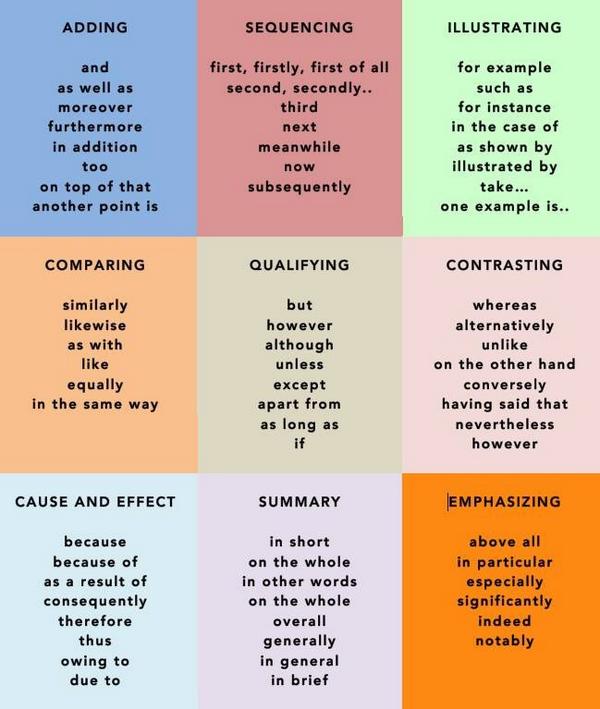
Here you have a list of useful connectors. Do you know them all? Look them up if necessary!

Image result for connectors english


Sentence Connectors are a great way of improving your English. Why? Because we use them to make more sophisticated sentences.

Example: “London is a very exciting city; nevertheless it is also very expensive” or
Despite the fact that London is very expensive, it is also very exciting”


! Some connectors are followed by a NOUN/ -ING FORM (despite/ in spite OF/ because OF/...), whereas other connectors need to be followed by a subject+verb.

Image result for connectors that are followed by a noun


There are various types of connectors. It's not important that you know them all yet, but this information will be handy in a few months.

We can divide sentence connectors into:

Coordinating Conjunctions

They connect words, phrases and clauses. They are usually found in the middle of a sentence with a comma (,) just before the conjuction, or at the beginning of the sentence.
Coordinating Conjunctions:
for
and
nor
but
or
yet
so

Correlative Conjunctions

They connect equal sentence elements together (like two nouns) and are always composed by two words.
Correlative Conjunctions:
both…and
not only…but also
not…but
either…or
neither…nor
whether…or
as…as

Subordinating Conjunctions

They connect a dependent clause and an independent clause and establish a relationship between them. They happen at the beginning of a sentence (with a comma in the middle separating the clauses) or in the middle of a sentence with no comma.
Subordinating Conjunctions:
afterifthoughalthough
if onlytillasin order that
unlessas ifnow thatuntil
as long asoncewhenas though
rather thanwheneverbecausesince
wherebeforeso thatwhereas
even ifthanwherevereven though
thatthatwhile

Linking Adverbs and Transition Words

They connect two independent sentences. They provide transition between ideas. They come at the beginning of a sentence or after a strong pause, such as ";" and are often followed by a comma.
Linking Adverbs and Transition Words:
accordinglyhowevernonethelessalso
indeedotherwisebesidesinstead
similarlyconsequentlylikewisestill
converselymeanwhilesubsequentlyfinally
moreoverthenfurthermorenevertheless
thereforehencenextthus


Now practise the use of connectors (there are 14 exercises, with answers): CLICK HERE


2) SPEAKING PRACTICE: EDUCATION

a) You'll watch a short video (7 min) in which you'll see how a set of 6 questions regarding education could be answered. Remember that in your final exam you'll be asked to answer some questions too, so this is going to help you a lot. Watch, listen and read!

b) Now prepare your own answers for the 6 questions. Remember to use connectors to link your ideas.